MARKETING TIP VIDEO: How to Rank Higher on Google – 10 SEO Tips
This is How You Get On Page One of Google Search
SEO Tip #1: Discover Your Target Keyword Phrases
Think about your product, then consider any keyword query someone might make on Google that relates to it. All of these queries, be they navigational, informational, or transactional, are potential keyword phrases. The best SEO strategies have keywords that target different intents (such as researching a topic or desire to make a purchase) and create content that matches that intent. You’ll need to develop a list of these keyword phrases then consider which phrases are the main targets. All of these tips center around the tactic of having a landing page that will rank for one primary phrase and may rank for variations of that phrase. You’ll want to choose phrases that match up with content legitimate for your domain. Your prime phrase should have adequate search volume, but not be so competitive that it will be almost impossible to rank regardless of your SEO efforts.
SEO Tip #2: Build Landing Pages for Each Phrase
The only way you’ll rank for a targeted keyword phrase is to build a specific page with content that is optimized for that phrase. Google looks to match content with searcher intent as closely as possible, so if a page focuses on that topic it will do better. For example, we wanted to introduce our marketing services to barbers who needed websites and online advertising. We targeted these keyword phrases:
- Barber marketing
- Barber marketing ideas
- Barber marketing tips
- Barber marketing strategies
Then, we used our blog to create a page with informational content on how to market a barbershop. This is an informational page created to help barbershops with marketing ideas rather than a sales page strictly promoting our services. With this helpful content, we match the intent of the search (as Google views it) and are able to rank on page one for each of our target phrases. These phrases are, in a sense, low-hanging fruit. Their search volume is not huge so they’re not super competitive to rank for, but they’re valuable because they target our audience demographics. In just a few months these terms have made it to the top 20 traffic drivers for the site.
SEO Tip #3: Use Keywords In Your URL and Meta Data
This is a standard practice with keyword placement. For example: Use the keyword phrase in the title of page and in the meta title tag and description:
 Also, include the keyword in your heading tag, like this: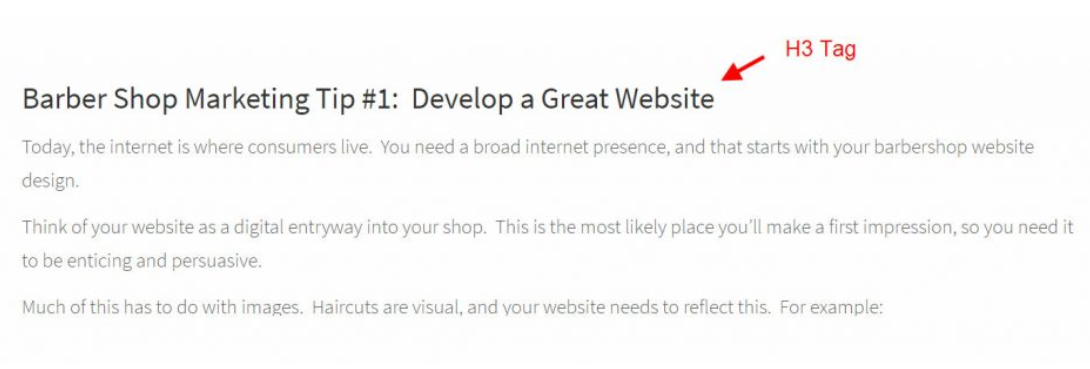
SEO Tip #4: Make the Content Valuable
This is now the main factor in how well your content will rank. You need comprehensive, well-written content that uses a variety of images, text, and videos to explain your point. On the barber page, we have images, videos, text and outbound links that provide engaging, useful content for people looking for tips on how to market a barber shop. This post has 1728 words, which is a great length for SEO purposes. However, nowhere do we extend the material just for the sake of making it longer or to use the keyword frivolously. Keyword stuffing is a hopelessly out of date tactic; if your SEO copywriter is using it, fire them. Your keyword query is a topic – it might even be in the form of a question. What you want to do is create the most comprehensive, useful, interesting answer to that question on the internet. If you do, you’ll engage readers and earn inbound links, both of which do a lot for your ranking. Take the time to develop excellent content on informational landing pages. Short, incomplete, sloppy content will never rank, so it’s not worth creating in the first place.
SEO Tip #5: Include Calls to Action on Informational Landing Pages
While your informational post’s main job is to provide value to visitors, it’s also a business page. You’ll want to have a call to action and links to product/service pages so people can take the next step and convert into a lead or customer. For example, on our blog posts we have a call button, links to subscribe to our YouTube channel and Facebook group, a link to tour our solution.
SEO Tip #6: Add a Video
We’ve seen evidence that adding a video, usually embedded from YouTube, boosts SEO rankings. Google views videos and other types of media like infographics as adding richness to the page content. It’s best when you create your own videos and infographics, but you can embed any public video from YouTube if it pertains to what you’re discussing. There are a lot of good informational videos on YouTube, and you could choose any so long as it’s not promoting your competition. On the barber page we embedded an example commercial a shop posted. The post you’re reading, of course, has a video with JB covering these topics.
SEO Tip #7: Update Your Content
Pages that are static for too long tend to fall out of ranking, particularly if they’re not getting a lot of traffic through search or links. It’s helpful to update your most important pages, like evergreen articles (articles with content that is not time sensitive) or main articles that are part of your website navigation. This is worth doing on important pages at least annually and should be done with the goal of making sure the content is up to date. Add tips, new videos or images, and ideas that keep things fresh. Another trick we use is to pull snippets of our blogs onto the service pages that go with the blog category. Each post updates the content on the main category page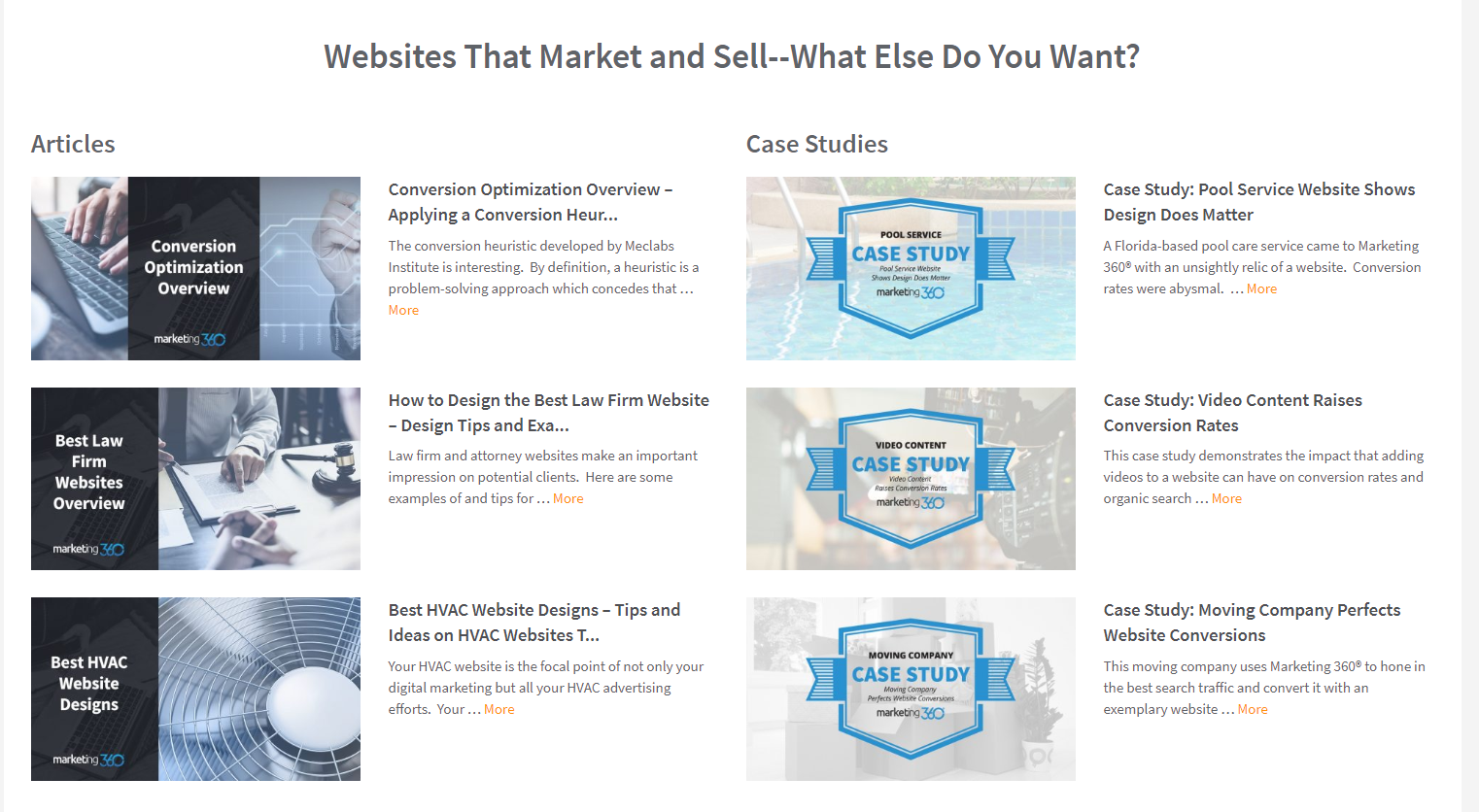
SEO Tip #8: Create an Internal Linking Architecture
Use text hyperlinks from supporting pages to link back to the hub page you want to rank. Be careful to do this naturally. Link to the page when it makes sense to guide a reader there. Also, vary the keywords phrase you use to avoid looking spammy and increase the semantic relevance of your content. For example, when linking to our SEO page I use other terms like organic traffic, search marketing, search ads, keywords, SEO management, and so forth. If it relates to your main term you can use it to vary your hyperlinks.
SEO Tip #9: Add Key Pages to Your Navigation
Along with linking to your main landing pages, you may want to have them be part of your main navigation. For example, say you’re a tax attorney. You’ll probably have a main page in your navigation that describes your services. This is also a page you can use the techniques we’ve described here for optimization. When this page is in your navigation, it will be seen as the central page. You can also use canonicalization tags to indicate to Google that a certain page is the master page of the content. This is necessary if you have subpages that have similar or duplicate content. The canonicalization tag tells Google which of those pages you want to rank.
SEO Tip #10: Do Some Paid Advertising
One thing about SEO. Traffic begets traffic. You can give your content a boost by doing some paid advertising to drive traffic. This can get things started on Google search, and may be the only way you can get much exposure on Facebook News Feeds because the algorithms are biased against organic ranking for anything promotional. Trying boosting your posts and running Adwords and Bing Ads to your focus pages. With long tail, informational type searches, the cost per click will likely be low. As you gain more traffic, you have the chance to get more backlinks and your organic ranking will move up. Also, be sure to set up remarketing so you can deliver a sequence of ads to visitors after they come to your website. Most people who enter your site on an informational landing page won’t convert on this initial visit. But when you retarget them, you get them into your sales funnel and gain valuable brand awareness.
SEO Tip #11: Get Backlinks
Backlinks from other authoritative domains are still a key to ranking for competitive keywords. However, you don’t have that much direct control over gaining natural backlinks other than to promote your content and ensure it’s high quality so people will be willing to link to it. One thing to do is use Twitter and LinkedIn to reach out to influencers and let them know the page exists. Better yet is to quote this type of person in the post then use their Twitter handle to message them. You might also message other businesses on Facebook to make them aware of a specific piece. Overall, you’ll earn more backlinks if your content is the best available on the subject. For high-performing keywords, it’s worth it to make the effort and gain that page one ranking.