Is it Time to Retire Demographics? Marketing 360® Reviews
Say you sell baby strollers. You want to set up a targeted advertising campaign.
So you put together some demographic data to target:
- Married women
- Ages 23-30
- Lives in a single family home
This is the kind of demographic data marketers have used for years to help them target advertising campaigns.
Demographic segmentation is based on hard data. It gives you info on age, race, religion, gender, family size, ethnicity, income, and education.
But let’s back up a second. You sell strollers, so married women ages 23-30 living in a single family home is a starting point. But for one of them to actually be motivated to buy a stroller, she’d have to be pregnant.
It’s entirely possible for a woman to be in this audience and not be planning a family. She fits the demographic, but not the target audience.
Pregnancy is a life event, not a steady demographic. The question is, how do you target something as personal as a life event?
Marketing Expectations
Advertisers have been asking this question for years. Andrew Pole of Target was one of the first to find the answer – in data.
Pole analyzed data from women who signed up for Target’s baby registry. He already knew if they started buying strollers and cribs that was a sign they were pregnant. But he wanted to see if he could detect this earlier so he could start sending them targeted advertisements.
The data was revealing – far beyond demographic targeting. Women in their second trimester started buying unscented lotion instead of scented lotion. At the beginning of their third trimester, they started buying cotton balls and washcloths.
Pole’s targeting was almost too good. Women started to get spooked, feeling Target was spying on them.
In one case, a man came into a Target store, furious. He wanted to know why Target was sending his 18-year-old daughter advertisements for baby products. The store manager, unaware of the campaign, apologized for the mistake. He was shocked.
In fact, he felt so bad he called the father to apologize again and offer him some discounts.
In turns out the father was the one with the apology; there was behavior going on in his house he was unaware of.
The targeting was working perfectly. The daughter was expecting late that summer.
Time to Retire Demographics?
H. Stuart Foster, VP of Global Brand Marketing for Hilton, suggests that it’s time to retire demographics:
“The time has come to officially retire the term “demographics” from every marketer’s vocabulary. Demographics are dead, because the way marketers think about their audiences today is completely different than it was 15 or even 5 years ago. Instead of simply relying on age, race or income, marketers now have access to big data and analytics.
Today we have the ability to segment audiences beyond demographic labels by thinking about mindsets – the complex mix of expectation, individuality and needs that personify a customer of any generational cohort, any ethnicity, any income level.”
Targeting mindsets, interests, and personal life events are far more viable for all businesses today than they were just a decade ago.
Targeting demographics isn’t enough. You have to know what your customers want and where they are in the buying process. In a way, you need to know what they want before they do.
Facebook Detailed Targeting
There are many technologies and platforms providing data that will let you target audiences like Andrew Pole did, but nowhere is it more robust than Facebook.
Facebook has an enormous amount of data on users. This comes from their Facebook activities, and also from third party data sources on buying behavior. Facebook notes detailed targeting may be based on:
-
What people share on their Timelines
-
Apps they use
-
Ads they click
-
Pages they engage with
-
Activities people engage in on and off Facebook related to things like their device usage, purchase behaviors or intents, and travel preferences
-
Demographics like age, gender, and location
-
The mobile device they use and the speed of their network connection
Do you watch NFL games on a mobile app? Facebook knows it. Do you take medication for high cholesterol? Facebook knows it. Are you graduating from school soon? Facebook knows it.
You can dial in your advertising campaigns based on these details, using flex and/or exclusions, allowing you to get extremely specific.
For example:
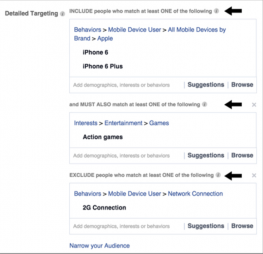
This campaign would include people with an iPhone 6 who like action games, but exclude people who have a 2G connection.
There is, in fact, almost no limit to how specific you can get with your ad targeting. One marketer became known by running a joke campaign that specifically targeted one person, his roommate.
It’s the opposite end of the spectrum from general demographic targeting. The mistake you have to avoid now is targeting so specific that you don’t have a big enough target audience to drive revenue.
Preferences and Timing
Today, advertising comes down to targeting personal preferences, as well as having perfect timing.
H. Stuart Foster notes how we must understand every client’s personal preferences and tailor the experience we create for them:
“In the hospitality industry, we marketers should consider factors such as how guests like to be greeted upon arrival at a hotel. One type of customer may prefer to be greeted in person, while another customer might like to receive immediate access to their room via digital tools, without any interaction with front desk staff. Both customers may have chosen the same hotel, but they clearly have different preferences – even if their demographic statistics are similar.”
This is true for all marketing. If you’re a wedding planner, you want to put ads in front of people who are actually planning to get married. If you’re a real estate agent, you want to market to people who are planning to move.
Likewise, if you’re planning to move yourself, you’ll be far more receptive to ads from real estate agents – you might even welcome them.
That’s a huge change from broad outbound campaigns that used to target everyone, or even demographic campaigns that were partially targeted at best.
Demographics may not need to be retired, but they certainly need to be modified. Age, gender, and location are just not enough.
To reach today’s consumers, you need to transform your ads from something that was an interruption into something that’s welcome content.
That comes from knowing exactly what they want, just when they need it.