Life Event Ads and the Rise of Predictive Advertising
Life events promise advertisers opportunities to display ads to just right people at just the right moment.
We recently spoke to a woman selling jewelry she felt would be popular with millennials. She indicated, then, that she’d like to target her ads on Facebook to that demographic.
All we could say was Good luck with that. You might as well target people based on their hair color.
Taken aback, she asked if we had a better suggestion. We did.
First, we looked at her products. She had a ring set specially designed for newlyweds on their first year anniversary.
Then we told her we could target millennials who were newlyweds for a year. Or:
 “You can do that?” she asked with surprise.
Yes, we can.
Targeting Life Events
There are certain types of business offerings where it’s not so much who you target as when you target them that counts.
Eventually, we’re all potential customers for funeral home services. But obviously it’s only at a time when a family member has died that we actually need this service.
Same goes for moves, marriages/relationship changes, having kids, recovering from a medical condition, or a job change.
Say you offer a new type of baby formula and you want to advertise to expectant parents. Then you have baby foods that go up to toddlers. The most effective tactic is to target people when they actually need a particular product:
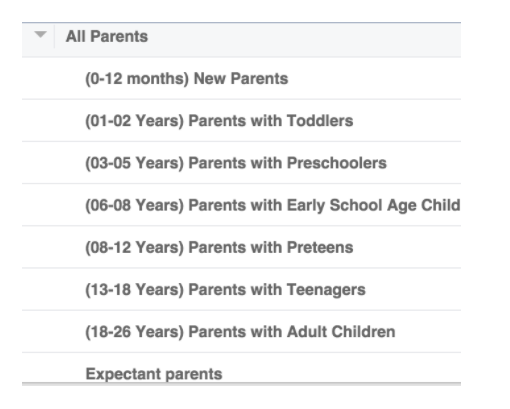
The more accurately you can target people who are at a point in their life where they need your product, the higher your conversion rates will be.
Predictive Ads: A Game Changer
It’s been suggested that demographics are dead. While this is not affirmed just yet, it is certain that the digital trail we create with our online behavior is creating data sets that dramatically expand on demographics.
Google has been noting this with how mobile search affects buying behavior in their micro-moments:
 Life events are another one of these moments where intent, context, and immediacy have a strong impact on the consumer’s drive to act. The key is being able to target the right moment.
Like Facebook, Google is moving towards using intent signals, consumer patterns, and life events that allow advertisers to micro-target their audience, using machine learning to predict consumers needs before they exist.
All of this stands to be a major game changer from the long-used tactic of targeting high-intent keywords. With keyword search, inbound marketing has to wait until the consumer expressly acts, demonstrating interest before they can put content in front of them.
Today’s technology is, interestingly, circling back to outbound marketing. It seeks to reach an audience before they act and express an interest or active need for the product.
But there is a huge difference. Facebook and Google now know what people are interested in. They know what types of products you buy and what’s going on in your life.
This means advertisers can create outbound ads that so strongly match the consumer’s needs, it’s not necessary to get their permission or have them initiate a search to advertise to them.
There are privacy concerns with how the digital advertising tracks our lives, but it’s worth considering how the loss of complete privacy has advantages for consumers.
Our jewelry retailer is happy. She’s targeting people with a precision she didn’t know was possible.
My 20th wedding anniversary is coming up. I’d much rather see ads for gifts my wife would love than for a funeral home I hope I don’t need for a long, long time.