Decentralization & The Marketing Narrative
Here is a quote from Jeff Immelt, CEO of GE, writing about the changing face of the global economy:
Winning requires simpler organizations. Change requires new business models that are leaner, faster, more decentralized. Complex and centralized bureaucracies are obsolete. GE is pushing capability to local teams who are empowered to take risks without second guessing.
He uses the the idea of “decentralization” thought this piece, repeating the theme that “complex and centralized bureaucracies are obsolete.”
We see (and use) the concept of decentralization often in the context of digital marketing and internet culture. In fact, it is one of the major topics experts continue to address. A perplexing realization underlies the thinking; the world wide web – the great digital connection machine – is doing more to decentralize leadership, authority, and bureaucratic cohesion than enhance it.
It’s a counter-intuitive result. Early on, the web was seen as a pathway to connections, a way to take disparate voices and unite them with unprecedented communicative power. Brands, politicians, schools, religious leaders – everyone in a position of authority – eyed these tools as a way to transmit their message to the masses with powerful efficiency. Control would surely come with such reach.
However, a problem arose. Anyone who’s seen The Matrix knows it:
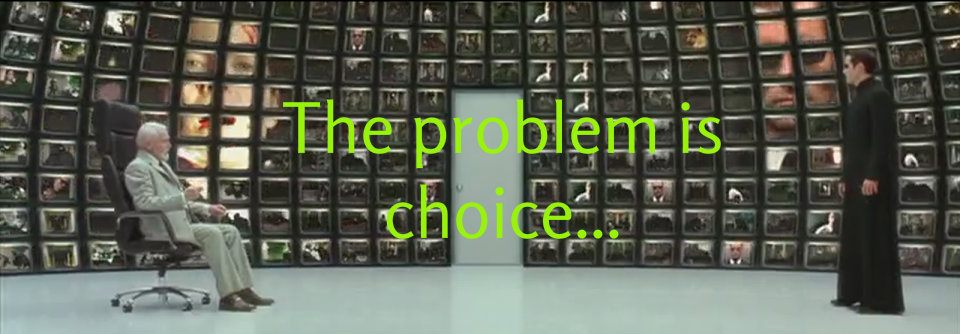
The internet doesn’t just bring the ability to deliver content. It also gives the choice to ignore it. Furthermore, it gives individuals remarkable power to create their own.
Early on, newspapers saw the internet as an opportunity to spread their publications to an almost limitless audience. Instead what happened is the creation of personal publishing tools so powerful individuals can create and curate their own publications. The news, they discovered, could not be “owned” and sold. More voices weighed in with ideas they shared for free.
The music industry momentarily envisioned selling CD albums online. Then Napster came along and they lost control of their own content. Instead of central platform to sell music, users copied it and curated collections for free.
Brand advertisers, once commanders of their image and messaging, are still coming to grips with fact that consumers understand their manipulative tactics, are inclined to skip their content altogether, and instead turn to fellow consumers to learn about the brand and its products. They once held central control of their image, but the communication floodgates social media opened decentralized the source. What was once a controlled brand voice is now an organic chorus of voices, so decentralized it borders on random.
For good or bad, indications are that the web does more to fracture people into smaller, like-minded groups than centralize them into large ones. It does as much to re-enforce existing attitudes as it does to change them. Given a choice, people gravitate to what they know and are comfortable with.
Back to Jeff Immelt’s quote. GE realized that they need to empower local teams who can make decisions without having to second guess what the larger bureaucracy would think. The internet didn’t create a way for the bureaucracy to control their resources. It did the opposite.
What does this mean for the consumer narrative in 2016 and beyond? If brands can’t create common narratives that reach their target audience, how do they gain attention? With communication platforms fracturing into more and more specialized modes, how do you create a central voice to run through them?
There’s no answer to these questions yet, but we can learn from GE’s experience. The internet has global reach, but it empowers at the individual, local level. People are writing their own narrative, curating their own experiences. Their choice is powerful and impossible to ignore.
The narrative is the consumer’s hands now. Centralized influence is obsolete. Smart businesses are giving consumers that win. They let them run with the narrative for free.
Brands can try to influence how consumers place themselves in their own story, trying to add to voices of the consumer’s choosing. When the brand’s offering connects to the person’s lifestyle, a business relationship can develop.
Lean, fast, and absolved of second guessing. Maybe it’s not what we thought the internet was going to accomplish for us. But I, for one, don’t think it sounds half bad.