This is How You Get a Product to Market Itself – Tips on Finding Your Early Adopters and Seed Audience
For many new products, it’s necessary to understand and target early adopters, which are also the seed audience you need to grow. Here’s how to approach this part of your marketing strategy.
Getting Your Product to Market Itself
When we talk about early adopters and seed audiences, we’re talking about an important marketing goal.
Basically, this goal is about getting your product to market itself. You want to reach a point where buzz creates more buzz, where popularity causes more popularity. You have a new style of jacket, and after a while, it’s seen by enough people that it becomes accepted. Sales take off from there.
Some products market themselves through luck. For unplanned and unintended reasons, the product becomes popular, branding multiplies, and organic growth kicks in. These are trendy products that often vanish as quickly and mysteriously as they arose.
With some product lines, planning for this type of luck is okay, so long as you know that’s what you’re trying to do. You may put a product out there that you know is quirky and not particularly useful, plan to expose it to a group and hope it takes off.
But you’re much more likely to be successful if you create a product that’s designed to be talked about.
The Adoption Cycle
When you bring a new product to market, you need to consider the product adoption cycle, typically represented in this bell curve:
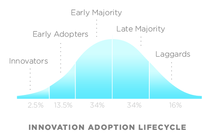
It starts with the first users, or innovators, then moves through popularity until the last group of laggards finally realizes they’re missing out.
Our point here has to do with innovators. A new product must tap into an innovator audience so that the product’s use in the public sphere creates marketing buzz. That buzz is what moves sales up the curve towards majority adoption.
The term “innovators” is often associated with tech products, which is why it might be helpful to think of this as a seed audience. Either way, it’s an initial cohort you target that will like your product – and will spread the word about how much they like it.
Identifying and targeting this cohort – with the strategic intent of turning them into advocates – is a vital marketing strategy too many businesses miss. Instead, they haphazardly start exposing their product, often using only basic demographics to target their advertising.
Moreover, they don’t use this strategy in the first place when they design their product. It’s an extra step. You’re not just creating a product a certain group of people will like. You’re creating a product which that group will talk about, planting a seed that grows into big sales.
Examples of Products and Brands That Market Themselves
Start with a simple question. What will your customers tell their friends about you?
For example, why would a restaurant create a BLT sandwich with over a pound of bacon? Does anybody in their right mind actually want to eat this entire sandwich?
This impractical sandwich serves a more important purpose than the profits it provides as a menu item. It creates a buzz that makes the restaurant regionally famous. People drive hundreds of miles just for the novelty of ordering a BLT so big they can’t possibly finish it.
Also, this sandwich is the reason a nationally televised food program like Food Paradise featured Tony’s. I live in Colorado, but now if I ever find myself in this area of Michigan I know what I’m having for lunch (and dinner).
The clothing line Ivory Ella is another example of a product designed to market itself. Their ingenious idea ties their clothing line in with admirable cause of saving wild elephants. This is a powerful way of using social purpose to market their product.
But their design goes a step further. Their clothing designs all feature an elephant. It’s their brand.

When customers wear their clothes, this design becomes a topic of conversation. Even better for their marketing, customers love sharing images of themselves wearing Ivory Ella on their social media channels. My daughter happens to be an avid fan of Ivory Ella, and she learned about it because her friends shared images of themselves wearing Ivory Ella shirts on Snapchat. Word spreads through #savetheelephants and #ivoryellalifestyle.
This business started with a worthy cause. But it’s also a fantastic marketing strategy that uses a product designed to create buzz. These are clothes people literally want to tell their friends about.
Harley Davidson is a pre-internet example of a business that built its brand with customer advocates. They literally turned their brand into a lifestyle. People who ride Harley’s base their personalities, personal styles, and friendships on the Harley Davidson brand. Their customers don’t just spread the word, they are the word.
Now a question for you. Have you ever seen a commercial for Facebook? Can you think of any advertising Facebook ever did?
The answer is no because Facebook doesn’t buy Super Bowl commercials or advertise online. They don’t have to.
Facebook is perhaps the greatest modern example of a product designed to market itself. It started with just 100 users in a Harvard dorm, and just by its own use and buzz became a worldwide phenomenon.
Wrap Up
Not every product or service can be engineered to be worth talking about. There is a reason you see so many Geico, Edward Jones or mesothelioma class action lawsuit commercials. People don’t talk about this stuff or share content related to it on social media. Same goes for many local services or commodity products.
But if your product’s marketing will benefit from its own usage, build your strategy around this virtuous cycle.
Carefully target your early adopters so they are a seed that grows into higher adoption levels. One tactic to be aware of is influencer marketing, where you get social media figures to use your product and share their experience with their audience. Be particularly aware of how your seed audience communicates and shares on social media, then position your marketing to become part of the conversation.
And last, be aware of how this affects your marketing budget. As you begin, you must understand the important benchmark of moving from your seed audience to early adoption. This takes time, and you need to have the resources in place to reach this point.
On the positive, when your seed grows into early majority adoption, a great deal of marketing will start to happen for you at no cost. In the best cases, the growth is explosive and self-sustaining.
It’s not just why your customers like your product that’s important. It’s the reasons they’ll feel compelled to share their experience with their friends that’s marketing gold.