Tips on Understanding and Targeting Searcher Intent

Not all searches have the same intent, and Google knows it.
Google’s technology infers what the searcher’s intent is and matches the results to it; it’s the crux of what a search engine does.
While this is a nuanced practice executed by artificial intelligence and vast algorithms, evaluation of search intent breaks down into three main categories:
- Informational: the searcher wants information on a topic to edify their understanding, help them complete a task, and assist in making further decisions about what content to access.
- Transactional: the searcher’s intent indicates an interest in buying a product or hiring a service. Content offered is intended for consumers.
- Navigational: the searcher is looking for a brand or service they’re aware of. For example, someone looking for a house might just search directly for “Zillow”.
So, Google starts, on the most general level, with the idea that a searcher either wants information, is going to buy something, or already knows the name of the place they want to go to.
While this might seem obvious, it’s actually a huge consideration in terms of how businesses execute paid and organic search marketing tactics.
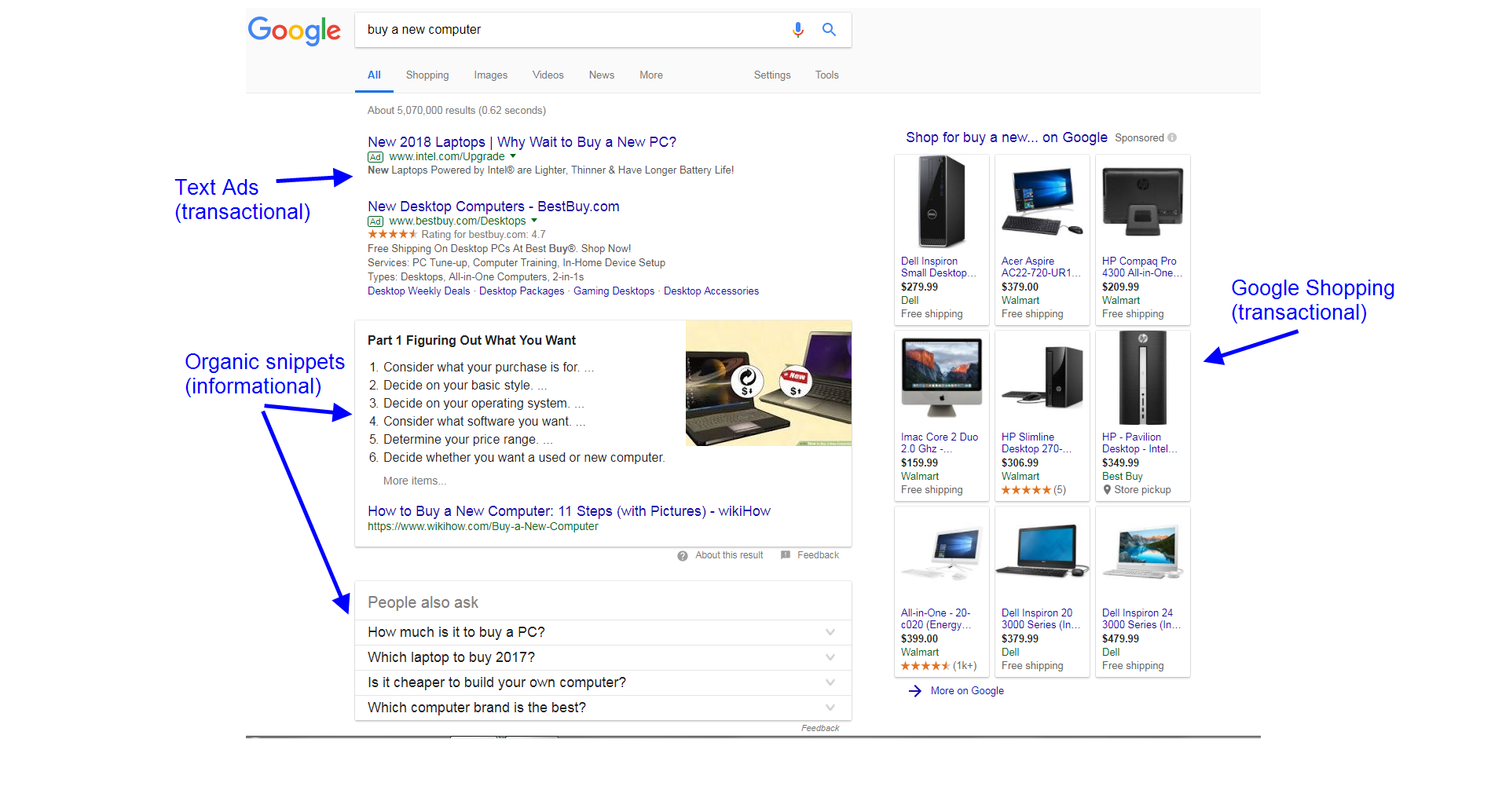
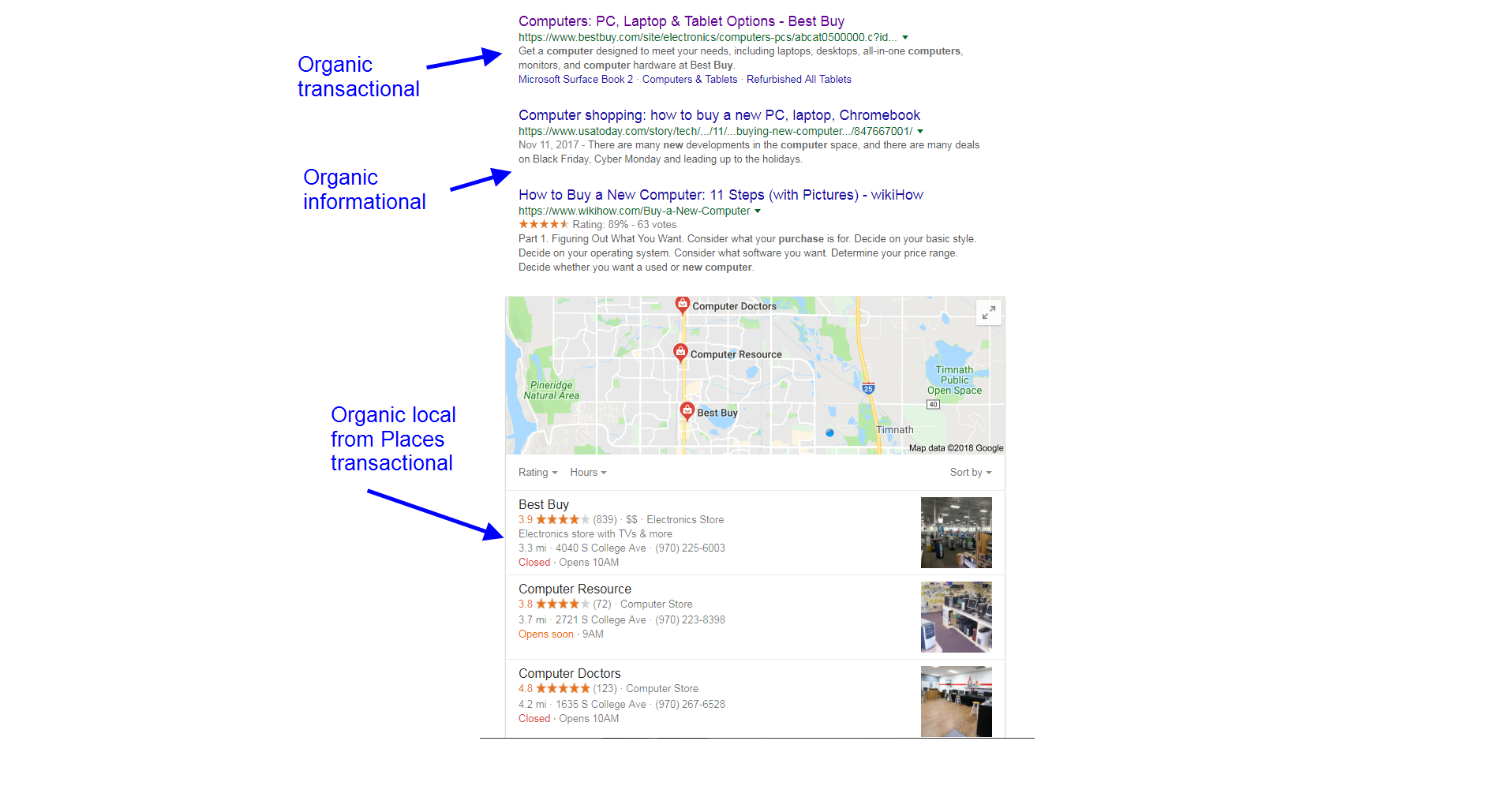
Let’s break each down, looking at a page one SERP for the search “buy a new computer”.
Here’s what we get above the fold:
Here is the middle section:
Here is the bottom third with organic text results:
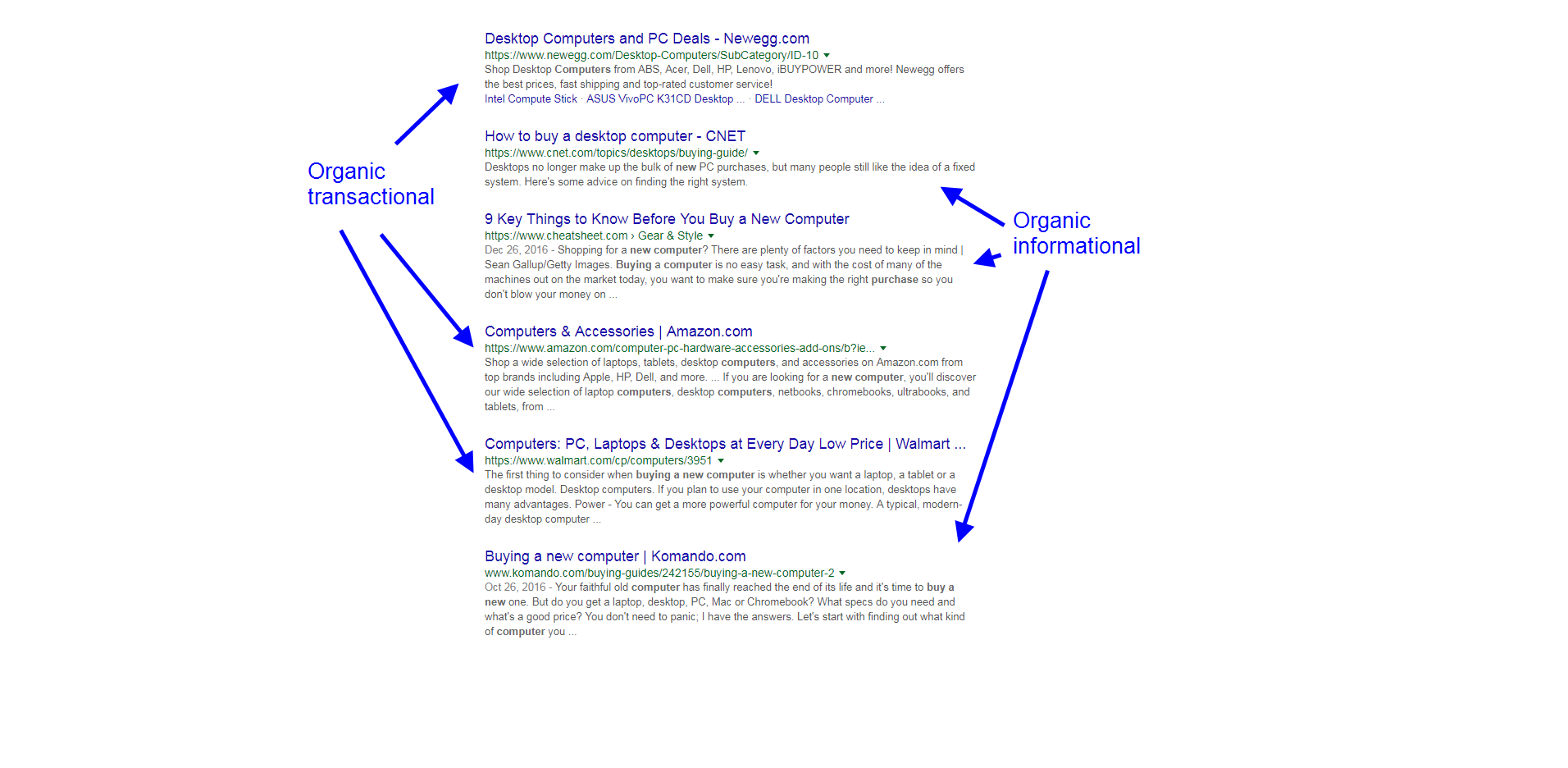
There is something important to note here. “Buy a new computer” is, in terms of diction, a search with transactional intent. We literally have the word “buy” in the query.
But even with this search, the top organic result – that’s featured in the snippet – is informational. Five of the nine organic text listings are informational.
Take another search like “law firm marketing”. This is a bit ambiguous, but certainly it’s possible that the intent behind this search is to find a marketing firm that specializes in law firms – a transactional search. There are four paid text ads at the top of the SERP that are all transactional.
However, of the 10 organic results, 9 offer informational content on “how to market a law firm”.
This is pattern you’ll discover in a lot of searches. Informational content gets a lot of attention in organic results.
The Key(word) Takeaway
There is one, key takeaway you need to get from this discussion.
At this point, Google has a strong tendency to favor informational content in organic results. If you want to rank organically for terms related to a particular concept, assume an informational intent from the searcher. The way you structure the content and Google’s tendency to rank informational content in organic results will give you a much better chance at getting on page one.
And consider the opposite. If you have content that is basically transactional, like a product category page or request an estimate page, you’re better off using paid search to drive traffic.
In many cases, it will be impossible to rank a page with transactional content in organic results. One reason is that, by their nature, transactional pages that drive people towards a particular action minimize content.
When you want someone to fill out a form or buy a product, you don’t want to put a 1500 word explanation of why they should do it in front of them. Transactional pages have short, direct response style content that drives people towards action.
Into the Funnel
The goal of informational marketing is to get people into the top of your sales funnel.

As you earn their trust by providing vital answers to their questions, they get introduced to your brand. Perhaps you capture an email address so you can put them into email marketing campaign.
They get on a retargeting list so they see your branded ads as they surf the web.
You direct them towards your social media so they follow you on Instagram or Facebook.
Then, when they hit the point where they must act, they do a transactional search. You use remarketing lists for search ads (RSLA) to bid higher on competitive, transactional searches.
Or, better yet, navigational search comes into play. The lead searches for your brand name – which you absolutely should be at the top of page one for.
At Marketing 360®, the search “marketing 360” is one of our top performers. But the reason it performs so well is that further up the funnel, probably when the lead just had a question about marketing, they discovered one of our informational posts. Or they might have done a transactional search and clicked on a paid ad, but not converted on that visit.
Either of those could be what started a chain reaction that led to brand recognition and a navigational search back to our site.
Those searches, at the end of a process that may have extended for months, are the ones that convert the best.