Why We Love Branding, Even Though We Don’t Believe It
Modern marketing is defined by the concept of branding.
At least it was.
There was a time when all you needed to be successful in business was a superior product. If you sold hammers or shirts or beers that were better than your competitions’, you had your selling advantage.
However, the later half of the 20th Century ushered in an era of where quality became more of a commodity. Products like cigarettes, tea, soaps, soft drinks – even cars and houses – found a market where quality alone wasn’t a way to differentiate. Products needed an identity.
So marketing as we know it began. Brands developed propositions that went beyond functional value by creating intangible, emotionally-based value. The goal was to develop a competitive buffer against functional parity. When the brand was perceived as superior, they could charge more for what was essentially the same product.
You see the results today in every aisle of the supermarket. You experience the brand mix: a combination of the logo, packaging, promotions, and all the advertising.
Which tooth paste is best? Which cat food or dishwasher soap? Is there any difference? Which feels best to you?
Brands become verbs that touch us emotionally. Apple innovates. Subaru loves. Nike wins. Patagonia explores.
Making this connection is no easy feat, which is why big brands paid advertising agencies to study their target audience and develop an emotional bond. Trust and quality were no longer enough. Brands needed to feel the love.
And it worked. McDonald’s – it could easily be argued – does not serve the best cheeseburger available. But their brand advertising helped them sell the most of them.
The Meat is the Brand
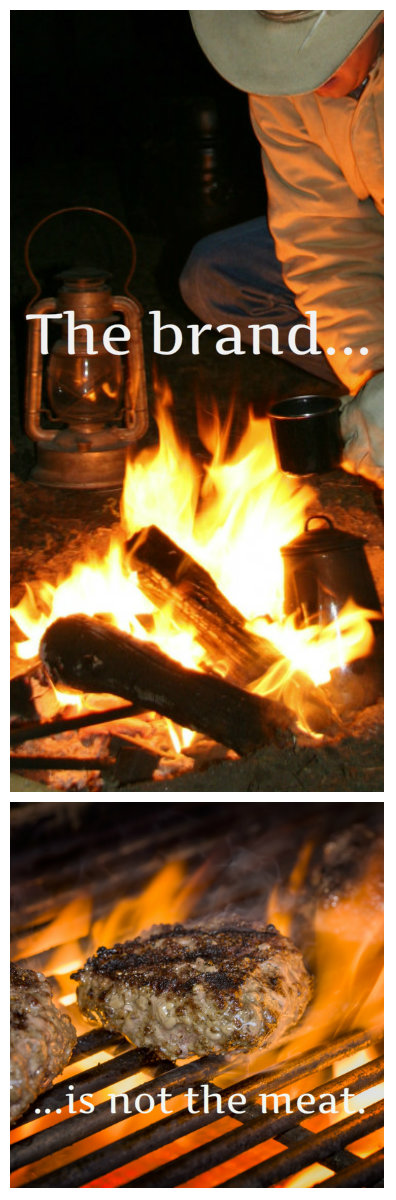 Many web marketing and usability experts like Gerry McGovern and Seth Godin describe alterations – if not the outright end – of the era of branding as we’ve know it.
McGovern goes back further in time to use the analogy of branding cattle, and how we came to believe that the brand burned on the hide – instead of the quality of the meat – was most important. He decries the branding practice of coming up with meaningless, interchangeable taglines (Coke: taste the love; Subaru: Love, it’s what drives a Subaru; McDonald’s: I’m loving it) and believing they’re more important than the quality of product. He thinks branding is bull:
“Branding in practice is the manipulation of human emotion, the targeting of human weaknesses, the wrapping of the product in an image that has got nothing to do with the product itself. The gushing, smiling faces of actors pretending to be customers. Branding is the mark of the establishment. The opposite of authenticity.”
Seth Godin talks about how permission marketing supplanted branding:
“Permission marketing is the privilege (not the right) of delivering anticipated, personal and relevant messages to people who actually want to get them.
It recognizes the new power of the best consumers to ignore marketing. It realizes that treating people with respect is the best way to earn their attention.
Pay attention is a key phrase here, because permission marketers understand that when someone chooses to pay attention they are actually paying you with something precious. And there’s no way they can get their attention back if they change their mind. Attention becomes an important asset, something to be valued, not wasted.”
Both of these ideas allude to internet empowered consumers. They research, fact check, and listen to what others say about brands more than what brands say about themselves. It suggests we are coming full circle: that we’re moving back to a world where the superiority of your product – confirmed by your customers – is more important than an image created by the brand itself.
Brand advertising is not dead. Businesses still pay big bucks to advertise during the Super Bowl. Emotionally laden messages still resonate with many consumers.
But branding is no longer at its height. There was a time when branding propositions exceeded all other value propositions for a product. A brilliant marketer could make people believe they preferred an inferior product.
But not today. McDonald’s, for example, learned in recent years that clever branding can’t overcome the fact that their burgers are sub-par. The meat, once again, is more important than the brand.
Interruptive ads with a message meant to manipulate consumer’s emotions seem to be reaching the end of a cycle.
So a new question arises. As consumers once again seek products based on quality, what do advertisers do about the problem of functional parity? Walk into a supermarket and you’ll find a host of products of almost – it not equal – quality to the category leader. Or try car shopping. Test drive a Subaru and Honda of similar models. Which is better?
5 Guys Burgers are better than McDonald’s. But what about Freddy’s Fryburgers? Or Smashburger?
Who has the best meat?
We know what we like. But it may remain that we need branding to tell us what we love.