The Online to Offline Buying Journey (What it is and How to Track it)
One of the crucial things to not only understand but also track is the buyer’s journey. If you want to verify how effective a marketing tactic is, you must track the interaction, start to finish.
With marketing confined to the digital sphere, this is easy and accurate. Someone clicks on an ad, they arrive on your website and they convert. Maybe they call, fill out a lead form or make a purchase. When they do, the software tracks the result.
However, this hasn’t always worked so well for tracking offline conversions. That’s a problem because the most common buyer’s journey of all is to research online and purchase offline. For some industries, like auto sales, this buying journey is all but exclusive.
Google has improved tracking for these buying journeys so businesses have data on how online ads are affecting their in-store sales.
Store visit conversions
The goal of store visit conversions is to gather data when someone clicks on a search ad and ends up in your store. They can only actually track people who are signed in to Google, so the algorithm extrapolates data to also represent non-signed-in users. Here’s their overview:
When the business correlates this data with in-store sales figures, they get an impression of how the online ad campaign drove sales. This data is not exact because of the extrapolated components and because of privacy settings (you can’t tie an individual shopper back to their online click).
Google offers a case study on how this works for Nissan UK:
In order to gather enough data for there to be a level of statistical significance, the overall amount of traffic and potential for in-store sales needs to be significant, so Google has requirements. You must:
- Have physical store locations in eligible countries.
- Receive enough ad clicks and impressions, as well as enough foot traffic in your business, to pass Google’s privacy thresholds.
- Have a Google Business Profile account linked to your Google Ads account.
- Create and verify a Google Business Profile for each of your store locations.
- Ensure location extensions or affiliate location extensions are active in your account.
- Have store locations that are not considered to be sensitive, such as locations related to religion, health, children or sexual content.
This campaign could be of immense value for businesses with physical locations, where sales transactions happen offline.
Local action conversions
Local action conversions, sometimes called navigation conversions, are counted whenever people complete an action that’s specific to an advertiser’s physical location (like a store), during or after interacting with an ad. These conversions happen through Google products like Maps and Google My Business listings.
Local action conversions give you a good sense of how well your ads are stimulating behavior that may ultimately drive offline sales.
Local actions you can track include:
- Clicks to call: Clicks on the “Call” button on any Google location-based ad or service after an ad interaction.
- Local actions – Directions: Clicks on the “Get directions” button on any Google location-based ad or service after an ad interaction.
- Local actions – Website visits: Clicks on the website link on any Google location-based ad or service after an ad interaction.
- Local actions – Other engagements: Clicks on other tracked user actions (for example: share location, save, etc.) on any Google location-based ad or service after an ad interaction.
- Local actions – Orders: (Vertical specific) Clicks on the “Order” button on any Google location-based ad or service after an ad interaction.
- Local actions – Menu views: (Vertical specific) Clicks on the menu link on any Google location-based ad or service after an ad interaction.
Here’s what the data looks like on Google Ads:
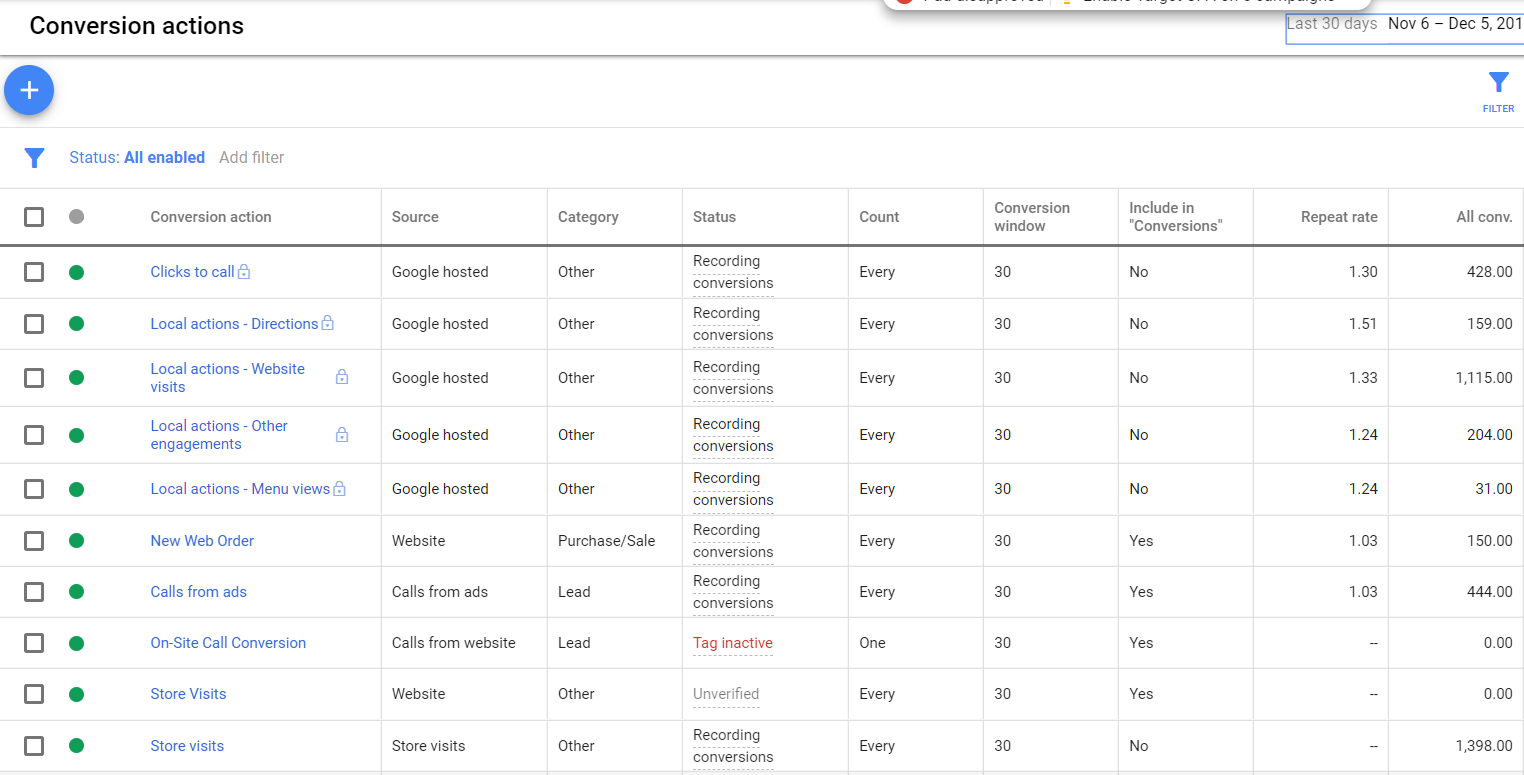
For example, the “directions” link click is an action this business can track. In this case, it is not included in the main conversion data. The call from ads is another local action, and in this case, it is included in the main conversion data.
Local inventory ads
Local inventory ads are shopping ads shown primarily on mobile searches. The idea is to catch shoppers who are in close proximity to your store and searching for a product you have in your inventory. When they see the ad with your location, they can buy offline at your store instead of buying online.
The ads click through to a Google-hosted local storefront that has an embedded map of your location. Here’s what it looks like:

You target these ads to ensure that you only show products you currently have in stock to people in close proximity to your store.
You can also adjust your bids based on the proximity of shoppers and whether or not they’re on a mobile device. So you could bid higher for shoppers who are within walking distance of your store conducting a search on their phone. Of course, you can control when the ads display so you only drive traffic during your open hours, and you can increase bids during times of day when traffic is higher.
With mobile tracking, you’ll also be able to track when the ads drive in-store sales and compare that data to the other types of ads you run.
Putting it together
This is really the bridge that local businesses need to understand how their online ads impact offline sales. Some businesses, like retail chains that sell high-end items or items that can’t be easily shipped, need to set up store visit conversions as soon as they’re able. This data will let you optimize your online ads to better serve the end of your sales funnel, which happens offline.
Any local retailer can begin to bring in online shoppers with local inventory ads. This is a type of ad that shoppers will really like because it gives them the opportunity to research online and buy in a store.
All local businesses need to start looking at local action conversion to get a better sense of how people interact with their content. When you have ads that are clearly getting higher interactions, this is a sign that you need to use that content more heavily.
It’s been predicted that online shopping will kill physical retail, but it has not happened yet and may never happen. The reason is that shoppers like buying things from physical retail stores. It’s tactile, social and can be more convenient. Instead of killing offline retail, online ads can now support it. It’s a win for both shoppers and businesses.
Originally published on 12/18/18